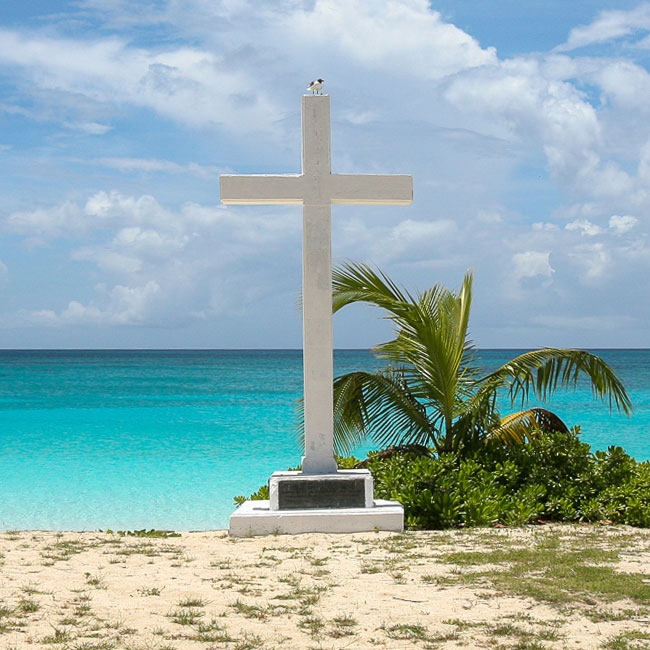
The cross placed where Columbus most likely landed when he discovered San Salvador
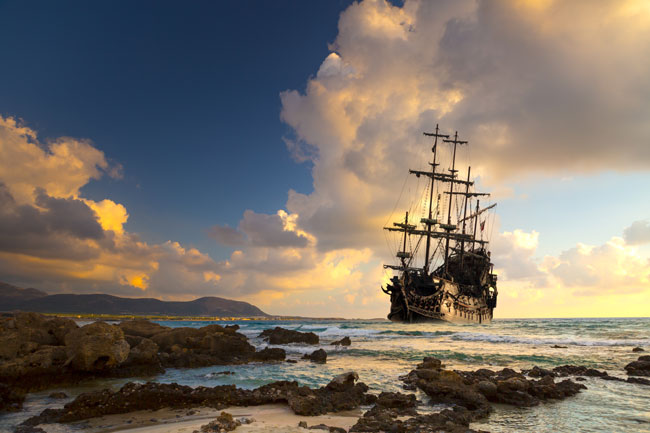
A ship arriving to San Salvador
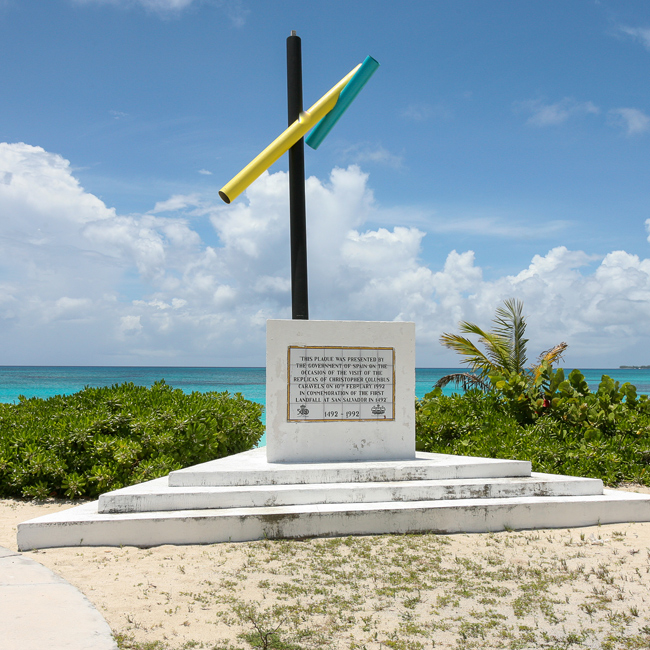
The monument (next to the cross) where Columbus most likely landed when he discovered San Salvador
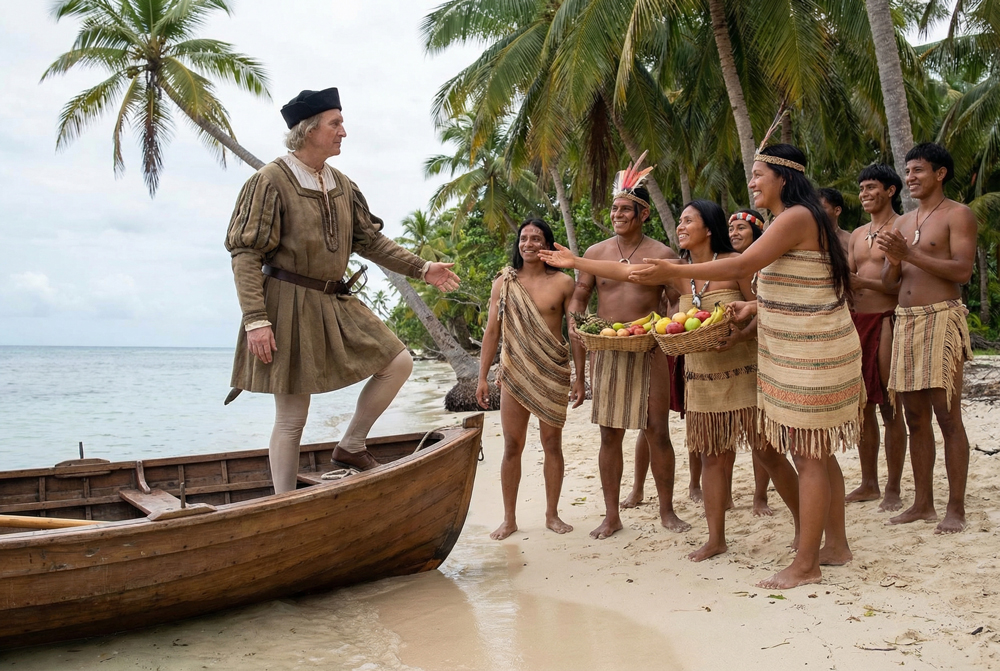
The Lucayan Indians supposedly thought Columbus and his men were gods.
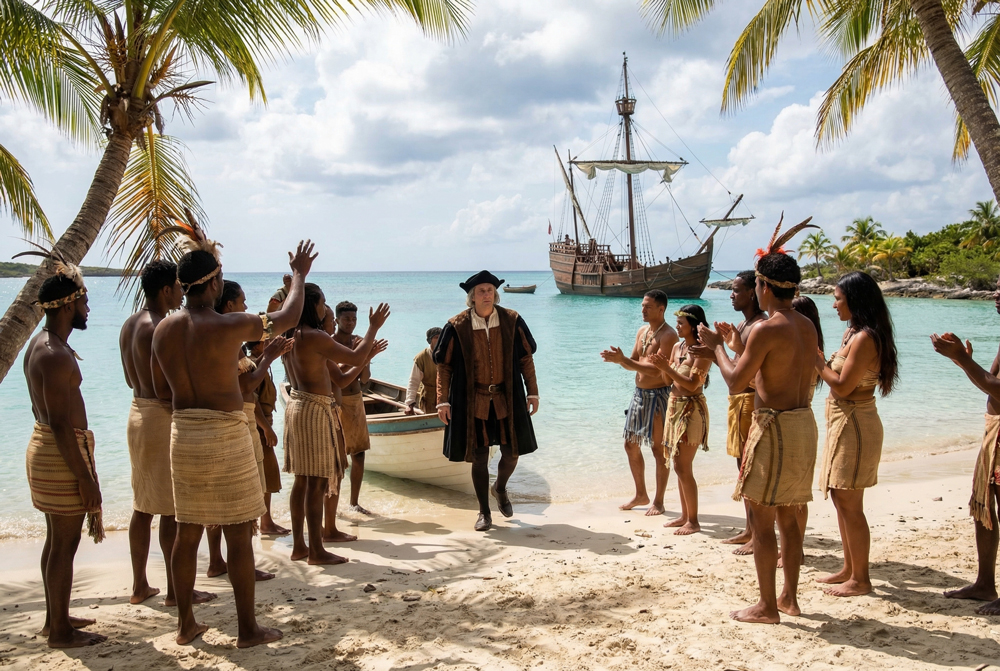
The Lucayan Indians meeting Columbus on San Salvador
A pirate ship arriving to San Salvador. There might still be treasure buried on the island.
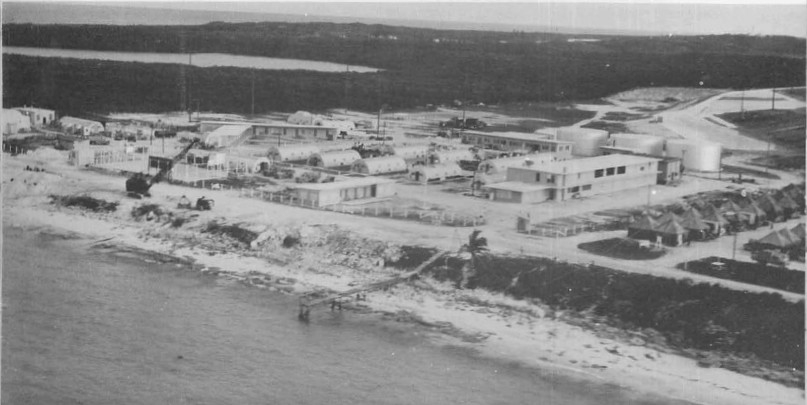
Air photo of the U.S. Coast Guard LORAN station under construction by the Naval Mobile Construction Battalion (Seabees, Detachment India), on the north coast of San Salvador Island, Bahamas circa 1958. This is the current site of the Gerace Research Centre. (photo from Commons.Wikimedia.org)
The Fascinating History of San Salvador Island in The Bahamas
San Salvador Island is one of the most historically significant islands in the Bahamas. Though quiet and lightly populated today, this small island played an important role in the early encounters between Europe and the Americas, as well as in the later Loyalist settlement period that shaped much of Bahamian history. From the arrival of Christopher Columbus in 1492 to the Loyalist plantations of the late 1700s, San Salvador’s story is deeply woven into the history of the New World. San Salvador ‘Holy Saviour’ was originally called Guanahani by the native Lucayan Indians who inhabited the island at the time of Columbus’ arrival. The island was later named Watling’s Island until 1926, when it was renamed San Salvador.
The Following Information courtesy of Bahamas Information Services, Department of Archives and Local Government
San Salvador - The Land of Lakes
San Salvador is also called the land of lakes and Columbus’ Isle. It is about 12 miles long and five miles wide. Its original name was Guanahani. Later it was called Watling’s Island after George Watling, a noted buccaneer. Until recently, San Salvador was considered one of the least important islands of The Bahamas. However, with the quincentennial celebrations in 1992, San Salvador attracted much attention as it has been for years identified as the first landfall of Christopher Columbus in the New World. He landed at San Salvador on October 12, 1492, and was greeted by the friendly Lucayan Arawaks.
San Salvador has a rich history: the depopulation of its indigenous population by the Spaniards; the use of its inlets by pirates and buccaneers; the coming of the Loyalists and their slaves; the coming of the Americans during the Second World War and its aftermath; and more recently, the advent of the tourist industry.
The San Salvador Museum located in the capital of Cockburn Town, in the ancient 19th century jailhouse and Commissioner’s Office, includes artefacts and replicas highlighting Columbus, the Lucayans, the plantation period and 19th century life on San Salvador. On the outskirts of Cockburn Town is the Heloise Monument, placed there by the yawl Heloise while on an around-the-world cruise in 1951 and is one of four monuments honouring the landfall of Columbus. Another monument is located at Long Bay. A white cross called the Columbus monument was erected in 1956 by Ruth Durlacher Wolper, an artist and writer, and stands next to the Mexican Olympic monument, erected in 1968 to commemorate the landfall of Columbus and the holding of the Olympic Games in the New World (Mexico) that year.
Lucayan Indians meet Christopher Columbus
As early as 300 to 400 AD, people who came from what is now Cuba (there was no country named Cuba at that time) lived on The Islands Of The Bahamas and relied on the ocean for food. From around 900-1500 AD the Lucayan people settled here. They enjoyed a peaceful way of life and had developed viable political, social and religious systems.
In 1492, Christopher Columbus made landfall in the New World on the island of San Salvador. Inspired by the surrounding shallow sea, he described them as islands of the "baja mar" (shallow sea), which has become The Islands Of The Bahamas. When he arrived, there were about 40,000 Lucayans. Their peaceful nature made the Lucayans easy targets for enslavement however. Within 25 years, all of the Lucayans were wiped out due to the diseases, hardships and slavery endured.
Arrival of the Loyalists (1783–1785)
When Britain lost the American colonies, thousands of Loyalists—colonists who had supported the British Crown — were forced to leave the newly formed United States. The British government compensated many of them with land grants in the Bahamas. Between 1783 and about 1785, Loyalists arrived on San Salvador (then known as Watling Island) bringing:
- * their families
- * enslaved Africans
- * farming equipment
- * the intention of establishing cotton plantations
The plantation economy on San Salvador lasted only about 20–40 years. By the early 1800s many plantations were already struggling due to:
- * thin limestone soil
- * insect infestations in cotton
- * hurricanes
- * high transportation costs
After the abolition of slavery in the British Empire in 1834, the plantation system effectively disappeared.
What Remains Today
Even though the plantation era was short, it left a lasting mark on the island. Visitors today can still see:- * stone plantation ruins
- * field walls built from limestone
- * cisterns and foundations of buildings
These ruins are scattered across the island and remain one of the most visible reminders of San Salvador’s late-18th-century Loyalist settlement period.
1700 - AGE OF PIRACY
During the late 1600s to early 1700s, many privateers and pirates came to The Bahamas, the most famous pirates being Blackbeard and Calico Jack. There were also female pirates like Anne Bonny and Mary Read disguised as men. We don't know if the pirates came to San Salvador, but it is reasonable to believe they did, on their way to Jamaica. We know that pirateer John Watlings came to the island.
The shallow waters and 700 islands made great hiding places for pirates and treasure. And our close proximity to well-traveled shipping lanes made for the perfect spot to steal from merchant ships.
More recent history of San Salvador
The History of the U.S. Military on San Salvador Island
Although San Salvador is known today for its quiet beaches and historic ruins, the island also played a strategic role during the Cold War. For several decades in the mid-20th century, the United States military operated facilities on the island to monitor submarines and assist with missile tracking. Many residents still remember this period as a time when the island suddenly had modern infrastructure, jobs, and an international presence.
Why San Salvador Was Strategically Important
San Salvador sits in a unique geographic position on the edge of the Atlantic Ocean, between North America and the Caribbean. During the early Cold War, the U.S. military recognized that this location was ideal for monitoring:
- * Soviet submarines operating in the Atlantic
- * missile tests launched from Cape Canaveral in Florida
- * navigation routes used by ships and aircraft
Because of this strategic location, the United States established several facilities on the island beginning in the early 1950s.
The U.S. Naval Base at Graham’s Harbour
One of the most important installations was built near Graham’s Harbour on the north coast of San Salvador. The base included:
- * radar and communications equipment
- * submarine detection systems
- * housing for military personnel
- * power generation facilities
- * docks and support buildings
A LORAN navigation station was constructed between 1957 and 1959 by a U.S. Navy construction battalion. LORAN (Long Range Navigation) was a radio navigation system that allowed ships and aircraft to determine their position using signals from land-based transmitters. Before GPS existed, this system was vital for navigation across the Atlantic.
Tracking Submarines During the Cold War
Another important purpose of the San Salvador installation was submarine detection. The base was part of a wider network used by the United States Navy to monitor Soviet submarines moving through the Atlantic during the Cold War. Hydrophones placed in the ocean detected underwater sounds and relayed them to monitoring stations on land. This system was part of what later became known as SOSUS (Sound Surveillance System), an underwater listening network designed to track enemy submarines. Although most of this work was highly secret at the time, San Salvador quietly became one small piece of the global Cold War surveillance network.
Supporting the Early Space Program
San Salvador’s location also made it useful for the U.S. missile and space program. Missile tests launched from Cape Canaveral, Florida passed over large parts of the Atlantic. Tracking stations positioned along this flight path collected telemetry and helped monitor missile performance. Facilities on San Salvador assisted in tracking test missiles and rockets as they traveled downrange over the ocean. This meant the island contributed, in a small but real way, to the early years of the space race.
The Military Leaves the Island
By the late 1960s, improvements in technology made some of the smaller monitoring stations unnecessary. The U.S. military gradually closed the San Salvador facilities, and the station was decommissioned around 1970. Many of the buildings and infrastructure were left behind and later repurposed.
From Military Base to Research Center
One of the most interesting transformations occurred at the old naval base at Graham’s Harbour. The site eventually became the Bahamian Field Station, which later developed into the Gerace Research Centre. Today this facility hosts:
- * marine biologists
- * geologists
- * archaeologists
- * environmental researchers
Students and scientists from around the world travel to San Salvador to study its reefs, wildlife, and geology — all on the grounds of a former Cold War military base.
A Little-Known Chapter of Island History
For many visitors, San Salvador feels like a quiet island far removed from global events. Yet during the Cold War, it played a small but meaningful role in the technological and military competition between the United States and the Soviet Union. Today the radar equipment and listening stations are gone, but the buildings remain — repurposed for science instead of surveillance. It’s a fitting transformation: from monitoring the world’s conflicts to studying the natural beauty of the island.